

Selank Research Peptide: Sequence, Structure & Technical Data
Selank (CAS 129954-34-3) is a synthetic seven-amino-acid peptide, Thr-Lys-Pro-Arg-Pro-Gly-Pro. It was designed by joining the natural immune peptide tuftsin to a short Pro-Gly-Pro tail that makes it more resistant to breakdown. It is studied in neuropeptide and neuroimmune research. This page is a laboratory reference covering its sequence, molecular data, research background, handling, storage and testing. For research use only. Not for human or veterinary use.
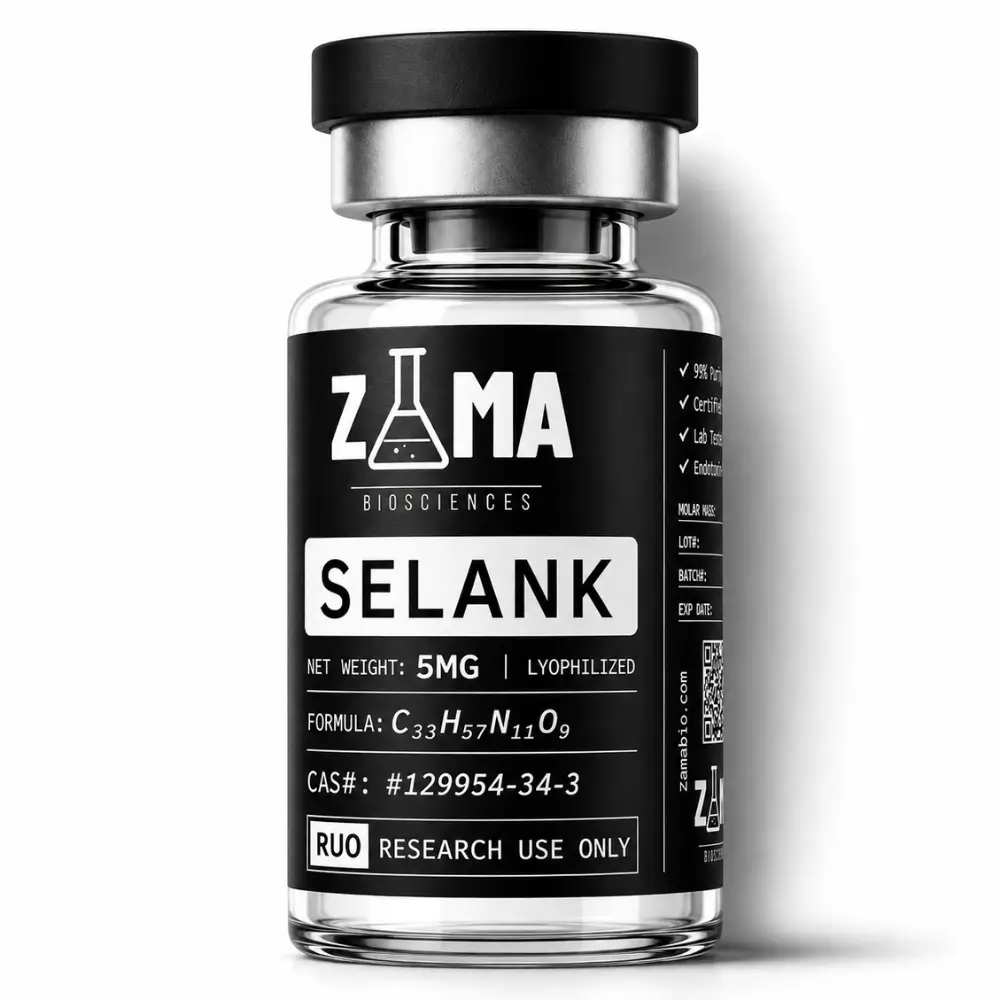
| Compound | Selank |
| CAS number | 129954-34-3 |
| Sequence | Thr-Lys-Pro-Arg-Pro-Gly-Pro (TKPRPGP) |
| Molecular formula | C33H57N11O9 |
| Molecular weight | ≈ 751.9 g/mol |
| Length | 7 amino acids, linear |
| Parent peptide | Tuftsin (Thr-Lys-Pro-Arg) |
| Form supplied | Lyophilized powder |
| Purity specification | ≥ 99% by HPLC, identity by mass spectrometry, lot-matched COA |
What is Selank?
Selank was developed at the Institute of Molecular Genetics of the Russian Academy of Sciences as part of a program building drug candidates from short natural regulatory peptides. Its starting point was tuftsin, a four-residue peptide released from the heavy chain of immunoglobulin G that acts on immune cells such as macrophages. Native tuftsin is broken down within minutes in biological fluids, so the developers added the tripeptide Pro-Gly-Pro to its C-terminus. The resulting heptapeptide is much more stable while keeping the tuftsin sequence intact (Kolomin et al., 2013).
Selank is registered as a medicine in Russia. It is not approved by the US FDA or the European Medicines Agency, and research-grade Selank is a laboratory reagent, not a pharmaceutical product.
Structure and sequence
- Tuftsin core (TKPR). Residues 1–4 are identical to tuftsin, including two positively charged residues (Lys2 and Arg4).
- Pro-Gly-Pro tail. Residues 5–7 protect the peptide from rapid cleavage by peptidases. The same PGP extension is used in Semax, a related peptide from the same research group.
- Proline-rich. Three prolines make the chain fairly rigid and resistant to many proteases.

Research background
- Enkephalin-degrading enzymes. Early biochemical work reported that Selank inhibits enzymes that break down enkephalins, the body’s own opioid peptides, in human serum samples (Zozulya et al., 2001).
- Behavioral models. Rodent studies have examined Selank in anxiety-related behavior tests, including in combination with diazepam under chronic stress conditions (Kasian et al., Behavioural Neurology, 2017).
- Gene expression and immune signaling. Because of its tuftsin origin, Selank has been studied for effects on cytokine and immune-related gene expression in cell and animal models.
Animal and cell results describe biology in specific models and cannot be assumed to translate directly to people.
Reconstitution and handling (laboratory)
- Let the sealed vial reach room temperature before opening.
- Selank is water-soluble. Reconstitute with sterile water, sterile water or a buffer suited to your assay, and swirl gently.
- Label each vial with the lot number and date, and split the solution into single-use aliquots.
See the Reconstitution and Storage guide and Reconstitution and Storage Water.
Storage and stability
- Lyophilized powder: sealed at −20 °C, protected from light and moisture.
- In solution: 2–8 °C short term, or aliquots frozen at −20 °C or below. Avoid repeated freeze-thaw.
How Zama Selank is tested
- HPLC purity (≥ 99% specification) and mass spectrometry identity against the expected mass of about 751.9 Da. See HPLC vs Mass Spectrometry.
- Net peptide content is separate from purity; see Net Peptide Content vs Purity.
- Lot-matched COA in the COA Library.
Frequently asked questions
What is Selank?
A synthetic heptapeptide (TKPRPGP) made by adding a Pro-Gly-Pro tail to the immune peptide tuftsin. It is studied in neuropeptide and neuroimmune research.
What is the CAS number of Selank?
129954-34-3. Its molecular formula is C33H57N11O9 and its molecular weight is about 751.9 g/mol.
How is Selank related to Semax?
Both were developed by the same Russian research group and both carry the same stabilizing Pro-Gly-Pro tail. Selank is built on tuftsin, while Semax is built on a fragment of ACTH.
Is Selank FDA approved?
No. It is registered in Russia but not approved in the US or EU. Research-grade Selank is for laboratory use only.
Researcher access
Selank is available to registered researchers. Sign in or create your researcher account to view Selank →
Related research guides: Semax · DSIP · KPV · Full Research Library
References
- Kolomin T, Shadrina M, Slominsky P, Limborska S, Myasoedov N. Neuroscience & Medicine. 2013;4(4):223–252.
- Zozulya AA, Kost NV, Sokolov OY, et al. Bulletin of Experimental Biology and Medicine. 2001;131(4):315–317.
- Kasian A, Kolomin T, Andreeva L, et al. Behavioural Neurology. 2017;2017:5091027.
Research Use Only. Selank and all products referenced are sold strictly for in-vitro laboratory research. They are not drugs, supplements or medical devices, and are not for human or veterinary use. This page summarizes published literature and makes no claim about any product. Statements have not been evaluated by the FDA.