

Semax Research Peptide: Sequence, Structure & Technical Data
Semax (CAS 80714-61-0) is a synthetic seven-amino-acid peptide, Met-Glu-His-Phe-Pro-Gly-Pro. It combines a short fragment of adrenocorticotropic hormone (ACTH 4–7) with a stabilizing Pro-Gly-Pro tail, and it does not carry ACTH’s hormonal activity on the adrenal gland. It is studied in neuropeptide and neuroprotection research. This page is a laboratory reference covering its sequence, molecular data, research background, handling, storage and testing. For research use only. Not for human or veterinary use.
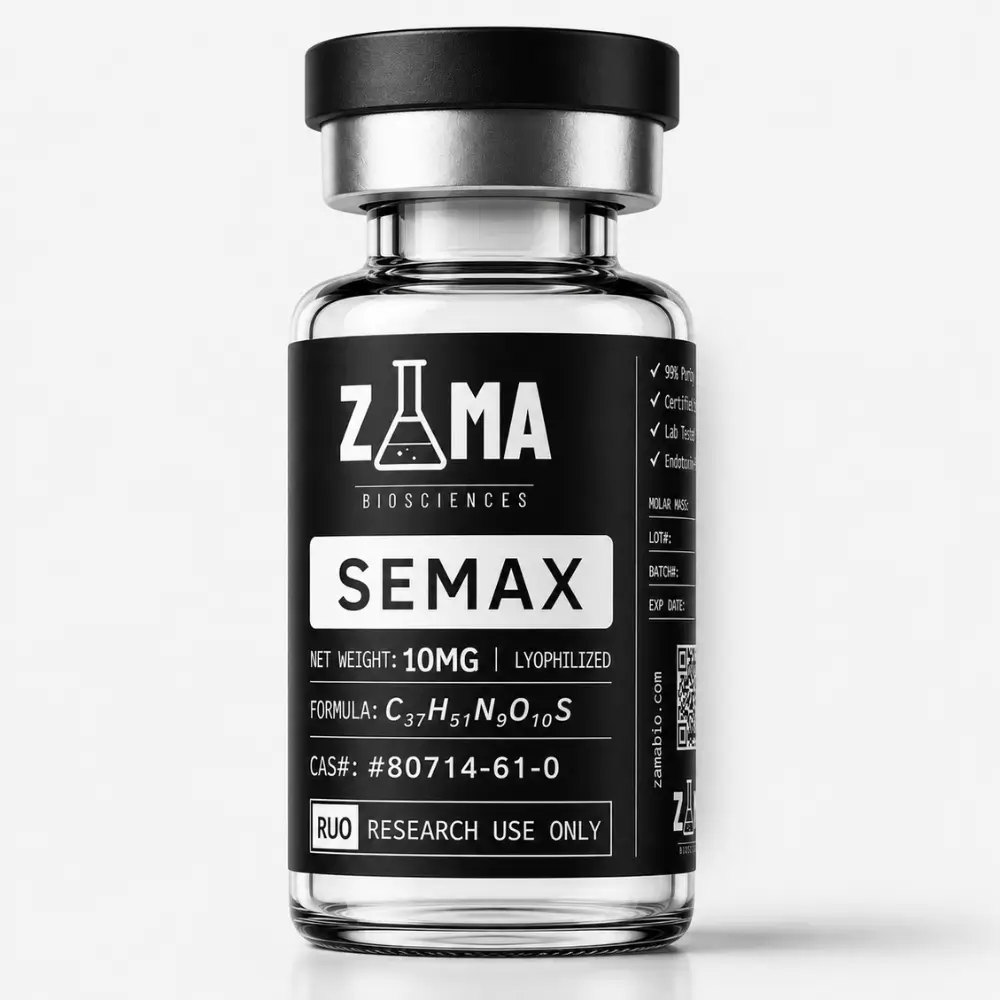
| Compound | Semax |
| CAS number | 80714-61-0 |
| Sequence | Met-Glu-His-Phe-Pro-Gly-Pro (MEHFPGP) |
| Molecular formula | C37H51N9O10S |
| Molecular weight | ≈ 813.9 g/mol |
| Length | 7 amino acids, linear |
| Parent sequence | ACTH(4–7) |
| Form supplied | Lyophilized powder |
| Purity specification | ≥ 99% by HPLC, identity by mass spectrometry, lot-matched COA |
What is Semax?
In the 1960s and 1970s, researchers found that short fragments of ACTH, especially the 4–10 region, affected learning and attention in animal studies even though they lacked ACTH’s effect on cortisol release. These fragments were broken down too quickly to be practical. Scientists at the Institute of Molecular Genetics in Moscow took the ACTH(4–7) sequence (Met-Glu-His-Phe) and added a Pro-Gly-Pro tail to slow breakdown, producing Semax (Kolomin et al., 2013).
Semax is registered as a medicine in Russia. It is not approved by the US FDA or the European Medicines Agency, and research-grade Semax is a laboratory reagent, not a pharmaceutical product.
Structure and sequence
- ACTH(4–7) core. Residues 1–4 (MEHF) come from ACTH. This region overlaps the “message” sequence shared by ACTH and melanocyte-stimulating hormones.
- Pro-Gly-Pro tail. Residues 5–7 protect the peptide from rapid cleavage. Selank, from the same research group, uses the same tail.
- Methionine 1 is sensitive to oxidation, which matters for storage and for reading mass-spectrometry results.

Research background
- BDNF and TrkB. In rat studies, Semax was reported to increase expression of brain-derived neurotrophic factor (BDNF) and its receptor TrkB in the hippocampus (Dolotov et al., Brain Research, 2006).
- Ischemia models. Genome-wide studies in rat models of focal brain ischemia examined how Semax changes expression of immune- and vascular-related genes (Medvedeva et al., BMC Genomics, 2014).
- Melanocortin context. Because its core comes from ACTH, Semax is often discussed alongside other melanocortin-derived peptides, although its exact receptor targets are still being studied.
Animal and cell results describe biology in specific models and cannot be assumed to translate directly to people.
Reconstitution and handling (laboratory)
- Let the sealed vial reach room temperature before opening.
- Reconstitute with sterile water, bacteriostatic water or a buffer suited to your assay, and swirl gently.
- Limit air exposure of solutions to reduce methionine oxidation, then aliquot and freeze.
See the Reconstitution and Storage guide and Bacteriostatic vs Sterile Water.
Storage and stability
- Lyophilized powder: sealed at −20 °C, protected from light and moisture.
- In solution: 2–8 °C short term, or aliquots frozen at −20 °C or below. Avoid repeated freeze-thaw.
How Zama Semax is tested
- HPLC purity (≥ 99% specification) and mass spectrometry identity against the expected mass of about 813.9 Da. A +16 Da peak can indicate methionine oxidation. See HPLC vs Mass Spectrometry.
- Lot-matched COA in the COA Library.
Frequently asked questions
What is Semax?
A synthetic heptapeptide (MEHFPGP) made from the ACTH(4–7) fragment plus a stabilizing Pro-Gly-Pro tail, studied in neuropeptide research.
What is the CAS number of Semax?
80714-61-0. Its molecular formula is C37H51N9O10S and its molecular weight is about 813.9 g/mol.
Does Semax act like ACTH?
No. It contains only a short ACTH fragment and lacks ACTH’s hormonal effect on the adrenal glands.
What is the difference between Semax and Selank?
Both share the Pro-Gly-Pro tail. Semax is built on an ACTH fragment; Selank is built on the immune peptide tuftsin.
Is Semax FDA approved?
No. It is registered in Russia but not approved in the US or EU. Research-grade Semax is for laboratory use only.
Researcher access
Semax is available to registered researchers. Sign in or create your researcher account to view Semax →
Related research guides: Selank · DSIP · Full Research Library
References
- Dolotov OV, Karpenko EA, Inozemtseva LS, et al. Semax, an analog of ACTH(4-10) with cognitive effects, regulates BDNF and trkB expression in the rat hippocampus. Brain Research. 2006;1117(1):54–60.
- Medvedeva EV, Dmitrieva VG, Povarova OV, et al. The peptide semax affects the expression of genes related to the immune and vascular systems in rat brain focal ischemia: genome-wide transcriptional analysis. BMC Genomics. 2014;15:228.
- Kolomin T, Shadrina M, Slominsky P, Limborska S, Myasoedov N. A new generation of drugs: synthetic peptides based on natural regulatory peptides. Neuroscience & Medicine. 2013;4(4):223–252.
Research Use Only. Semax and all products referenced are sold strictly for in-vitro laboratory research. They are not drugs, supplements or medical devices, and are not for human or veterinary use. This page summarizes published literature and makes no claim about any product. Statements have not been evaluated by the FDA.