Enter your email and receive 20% discount! 
RetZama, TirZama, SemZama, BPC-157, Cagrilintide — and the rest of the catalog.
Best deal auto-applies in your cart · Free shipping over $200, or instantly with the code below
By entering you confirm you are 21+ and purchasing research materials for laboratory research use only — not for human or animal consumption. Full disclaimer.
Shop the SaleSale ends Tuesday, September 8 at 11:59pm PT
Zama Biosciences sells research peptides exclusively to qualified researchers and laboratories for in vitro and laboratory use. Please confirm before continuing.
I am at least 21 years of age.
By proceeding you affirm the statements above are true. Products are not for human or veterinary use, not for use in diagnostic procedures, and have not been evaluated by the U.S. Food and Drug Administration. Full disclaimer.
Enter your email and receive 20% discount!
Not a researcher? Exit

Dosage
40 in stock
FedEx Express
HPLC Verified
Secure checkout
Same-day shipping
Technical specs
Pulled from the verification packet included with each shipment. Cross-check the batch ID on your vial against the COA.
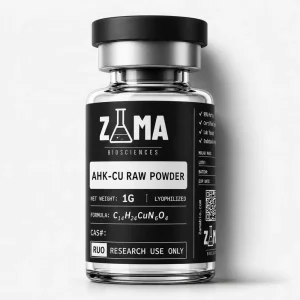
GHK-Cu is a tripeptide-copper complex: glycyl-L-histidyl-L-lysine bound to a divalent copper ion. Molecular formula C14H24CuN6O4, molecular weight 403.93 g/mol. Supplied here as raw powder at 1g.
The copper is not an additive — it is the functional core of the molecule. GHK binds Cu2+ with high affinity through the histidine imidazole and the terminal amine, and it is the complex rather than the bare tripeptide that most published work concerns. This is why the powder is blue: that colour is the copper coordination itself, and it is the most immediate visual confirmation that the complex has formed correctly.
GHK was originally identified in human plasma, where its concentration declines markedly with age — an observation that prompted much of the subsequent research interest.
Published work centres on extracellular matrix biology: collagen and glycosaminoglycan synthesis, metalloproteinase and TIMP expression, and fibroblast behaviour in dermal preparations. A separate strand examines gene expression profiling, where GHK-Cu has been reported to shift transcription across a substantial number of genes in cultured cells.
Copper-dependent enzymology sits behind much of this — lysyl oxidase, which cross-links collagen and elastin, and superoxide dismutase both require copper — so the peptide is often studied as a delivery mechanism for bioavailable copper as much as a signalling molecule in its own right.
For a fuller treatment of the sequence, published models and technical data, see the GHK-Cu research guide.
CAS number 49557-75-7. Supplied as a blue powder, soluble in water. This batch assayed at 99.22% purity, verified by HPLC and LC-MS at ILS Lab.
Reconstitute with bacteriostatic or sterile water, introducing the diluent against the vial wall and swirling gently rather than shaking. A loss of blue colour indicates the copper complex has dissociated and the material should not be relied upon.
Avoid chelating agents such as EDTA in buffer preparations, which will strip the copper. Store lyophilized at −20°C protected from light; refrigerate at 2–8°C once reconstituted.
Ships with a batch-specific Certificate of Analysis. Cross-check the batch ID printed on your vial against the CoA before use — see the guide to reading a CoA if you are unfamiliar with the format.
The colour is the copper coordination itself — a d-d electronic transition in the Cu2+ ion held by the peptide. It is not a dye or an additive. That makes it unusually useful as a quality check: blue means the complex has formed, and a loss of colour means the copper has dissociated and you are left with the bare tripeptide, which is a different molecule with different reported activity.
Because they compete for the copper. EDTA binds Cu2+ with higher affinity than GHK does and will strip it out of the complex, leaving unbound GHK in solution. Since most published work concerns the copper complex rather than the free peptide, that changes what you are studying. Screen buffer components for chelating agents before preparing solutions.
No, and the distinction matters. GHK is the bare tripeptide glycyl-histidyl-lysine; GHK-Cu is that peptide bound to copper. Much of the reported activity — particularly anything involving lysyl oxidase or superoxide dismutase, both copper-dependent enzymes — depends on the copper being present. Check which form a paper used before comparing results.
Both are copper-binding tripeptides studied in similar dermal and matrix contexts. AHK-Cu substitutes alanine for glycine at the first position. GHK-Cu has substantially the larger literature and is the better-characterised of the two, so it is generally the appropriate reference compound.
Research use only. Not for human or veterinary use, not for use in diagnostic procedures, and not evaluated by the U.S. Food and Drug Administration.
Molecular weight
Purity
CAS number
Storage
Form
Solubility
Batch number
Sequence
Molecular formula
Receptor activity
FAQ
We typically respond to all email inquiries within 24 hours on business days (Monday-Friday, 9am-6pm EST). For urgent order issues, please include your order number in the subject line for priority handling.
Once your order ships, you’ll receive a confirmation email with tracking information. You can also check your order status by emailing info@zamabio.com with your order number. Orders are processed within 0-2 business days, with most arriving within 3-5 business days from fulfillment. Every order includes free shipment protection.
We’re sorry to hear that! Please email info@zamabio.com immediately with your order number and photos of the damage. Photo evidence is required for all claims. Once verified, we’ll send a one-time replacement within 24 hours at no cost. One replacement per customer per order, subject to review.
Every order includes a batch-specific Certificate of Analysis (CoA) verifying purity, identity, and quality. You can also access CoAs on each product page. If you have questions about a specific CoA or need additional documentation, our support team is happy to help at info@zamabio.com.
While we cannot provide medical or therapeutic advice, our team can help you understand the specifications, purity levels, and research applications of our peptides. Email us with details about your research focus, and we’ll point you toward relevant product information and published studies.
Every order includes access to batch-specific Certificates of Analysis. CoAs are available on each product page and are also included in your order confirmation email. If you need a specific CoA or have questions about lab results, email us with your order number and we’ll send it right over.
Payment declines can occur for several reasons. First, ensure your billing address matches your card exactly. If issues persist, try a different payment method or contact your bank to authorize the transaction. You can also email us and we’ll help troubleshoot or provide alternative payment options.