
Enter your email and receive 20% discount! 
RetZama, TirZama, SemZama, BPC-157, Cagrilintide — and the rest of the catalog.
Best deal auto-applies in your cart · Free shipping over $200, or instantly with the code below
By entering you confirm you are 21+ and purchasing research materials for laboratory research use only — not for human or animal consumption. Full disclaimer.
Shop the SaleSale ends Tuesday, September 8 at 11:59pm PT
Zama Biosciences sells research peptides exclusively to qualified researchers and laboratories for in vitro and laboratory use. Please confirm before continuing.
I am at least 21 years of age.
By proceeding you affirm the statements above are true. Products are not for human or veterinary use, not for use in diagnostic procedures, and have not been evaluated by the U.S. Food and Drug Administration. Full disclaimer.
Enter your email and receive 20% discount!
Not a researcher? Exit
Dosage
2 in stock
FedEx Express
HPLC Verified
Secure checkout
Same-day shipping
Technical specs
Pulled from the verification packet included with each shipment. Cross-check the batch ID on your vial against the COA.
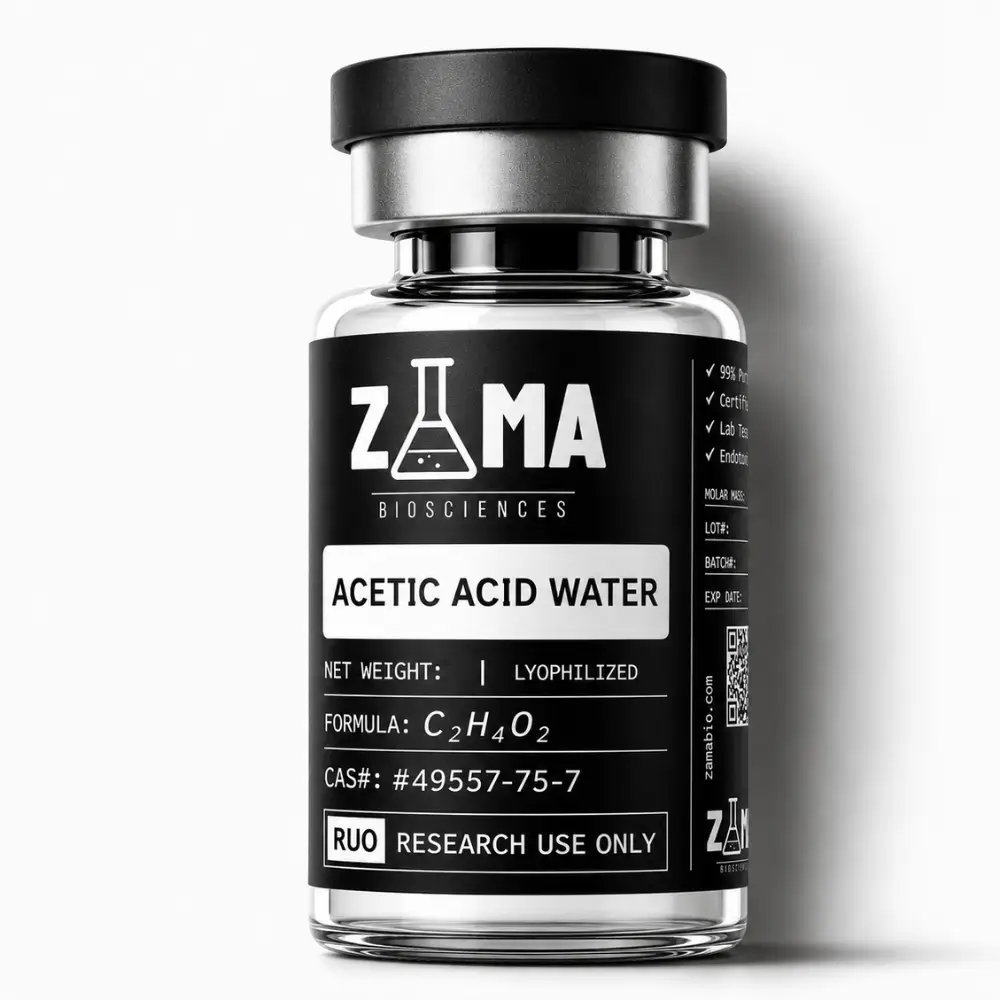
Dilute acetic acid solution supplied as a laboratory dilution standard. CAS 64-19-7, molecular formula CH3COOH (C2H4O2), molecular weight 60.05 g/mol. Clear liquid, miscible with water.
Not every peptide dissolves in neutral water, and forcing one that doesn’t is a common source of failed preparations.
Solubility depends on the net charge of the sequence at a given pH. Peptides rich in basic residues — lysine, arginine, histidine — carry a net positive charge under acidic conditions, and that charge keeps individual molecules repelling one another rather than aggregating. Near the isoelectric point, net charge approaches zero, and the peptide is at its least soluble.
A dilute acid brings the pH away from the isoelectric point for basic sequences and restores solubility. IGF-1 LR3 is the clearest example in this catalogue — it is specified for dilute acetic acid rather than bacteriostatic water.
Dissolve in the acid first, then dilute into your working buffer. The peptide stays in solution through the transition, whereas adding acid to an already-cloudy aqueous preparation rarely recovers material that has already aggregated.
Check the compound’s specification before choosing a diluent. Most peptides in this catalogue reconstitute in bacteriostatic water; only those specified for acidic conditions need this. Note also that acetic acid contains no preservative, so it does not confer the multi-dose stability that benzyl alcohol provides.
Store at room temperature and protect from freezing. Prepare working dilutions fresh where the protocol allows.
For a fuller treatment of reconstitution technique and diluent selection, see the reconstitution and storage guide.
Because of net charge. A peptide is least soluble near its isoelectric point, where positive and negative charges balance and molecules stop repelling one another — at which point they aggregate instead of dispersing. Sequences rich in basic residues such as lysine, arginine and histidine sit near neutral pH at their isoelectric point, so plain water is close to the worst possible solvent for them.
It shifts the pH away from the isoelectric point. Under acidic conditions a basic sequence carries a net positive charge, and that mutual repulsion keeps individual molecules in solution rather than clumping. The peptide is not chemically altered — the acid changes the environment, not the molecule.
It rarely works. Once material has aggregated, adding acid seldom recovers it. The correct order is to dissolve in the acid first, then dilute into your working buffer — the peptide stays in solution through the transition. Prevention is far more reliable than rescue here.
No. Use it only where the compound’s specification calls for acidic conditions. It contains no preservative, so it does not provide the multi-dose stability that benzyl alcohol in bacteriostatic water gives you across repeated withdrawals — and unnecessary acid exposure is a variable you do not want in an experiment that did not require it.
Research use only. Not for human or veterinary use, not for use in diagnostic procedures, and not evaluated by the U.S. Food and Drug Administration.
Molecular weight
Purity
CAS number
Storage
Form
Solubility
Batch number
Sequence
Molecular formula
Receptor activity

FAQ
We typically respond to all email inquiries within 24 hours on business days (Monday-Friday, 9am-6pm EST). For urgent order issues, please include your order number in the subject line for priority handling.
Once your order ships, you’ll receive a confirmation email with tracking information. You can also check your order status by emailing info@zamabio.com with your order number. Orders are processed within 0-2 business days, with most arriving within 3-5 business days from fulfillment. Every order includes free shipment protection.
We’re sorry to hear that! Please email info@zamabio.com immediately with your order number and photos of the damage. Photo evidence is required for all claims. Once verified, we’ll send a one-time replacement within 24 hours at no cost. One replacement per customer per order, subject to review.
Every order includes a batch-specific Certificate of Analysis (CoA) verifying purity, identity, and quality. You can also access CoAs on each product page. If you have questions about a specific CoA or need additional documentation, our support team is happy to help at info@zamabio.com.
While we cannot provide medical or therapeutic advice, our team can help you understand the specifications, purity levels, and research applications of our peptides. Email us with details about your research focus, and we’ll point you toward relevant product information and published studies.
Every order includes access to batch-specific Certificates of Analysis. CoAs are available on each product page and are also included in your order confirmation email. If you need a specific CoA or have questions about lab results, email us with your order number and we’ll send it right over.
Payment declines can occur for several reasons. First, ensure your billing address matches your card exactly. If issues persist, try a different payment method or contact your bank to authorize the transaction. You can also email us and we’ll help troubleshoot or provide alternative payment options.